History of the Environment Committee
Over the course of two decades, the St. C’s Environment Committee has worked to establish recycling, composting, solar panels, zero waste, clean-ups, nature walks, environmental films, Forums, letters to encourage environmentally-oriented voters to vote, a plant sale, a garden for Housing Up, support for Sustainable Villages Honduras, and now a partnership with WIN.
St. Columba’s Environment Committee
A Brief History
“The place God calls you to is the place where your deep gladness and the world’s deep hunger meet.” (Frederick Buechner)
The St. Columba’s Environment Committee was formed by a small group of parishioners in March 2001, with three principal objectives – understanding how our faith calls us to be stewards of God’s creation, encouraging the church and our fellow parishioners to lighten our footprint on the Earth, and educating ourselves better about the environmental challenges we face and taking direct action to address them. Over the years, encouraging environmental policies and actions in the larger community was added.
Our chairs and co-chairs have included Rosemary Dickerson, Reid Detchon, John Wickham, Maureen Hardwick, Mike and Kathy Hill, Nicole Holstein, Cynthia Laux-Kreidler, Penny Ray, Jeanne McCann, and Kris Moore (twice!). Three of our chairs have also been elected to the Vestry. Our current chair is Karen Abrams
Our accomplishments since 2001 include:
Faith and environmental stewardship
- Inviting guest preachers to share diverse perspectives on the religious obligation to protect God’s gift of the Earth, including repeat visits by:
- the Rev. Margaret Bullitt-Jonas, Missioner for Creation Care for the Episcopal Diocese of Western Massachusetts;
- the Rev. Sally Bingham, Canon for the Environment in the Diocese of California and founder of the Regeneration Project and Interfaith Power & Light;
- the Rev. Richard Cizik, President of the New Evangelical Partnership for the Common Good.
- Hearing the call from our own clergy as well, especially: the Rev. Steve Huber, Martin Smith, Peter Antoci, Margaret Guenther, Susan Flanders, Ledlie Laughlin, Joshua Daniel, and Amy Molina-Moore.
- Reflecting on God’s word through day-long workshops (one led by Sister Catherine Grace of the Community of the Holy Spirit – a monastic community for women in the Episcopal Church), and parish retreats (one led by the Rev. Peter Antoci).
- Supporting and implementing a resolution adopted at Diocesan Convention to celebrate a Season of Creation each September – to serve as a moral example in loving God’s creation and responding to the call to protect, conserve, and preserve this fragile earth, our island home.
- Integrating environmental themes into our liturgy, hymns, and prayers – even Sunday School lessons around Earth Day and the Feast of St. Francis.
- Leading wildflower walks every spring along the Billy Goat Trail, guided many times by Dr. Brent Blackwelder, to admire the beauty of God’s creation.
- Embracing a “Carbon Fast” for Lent, encouraging adoption of new green behaviors (instead of giving up chocolate!).
- Contributing books, videos, and other study materials on the environment and spirituality to the Craig Eder Library.
Reducing the impact of St. Columba’s on the Earth
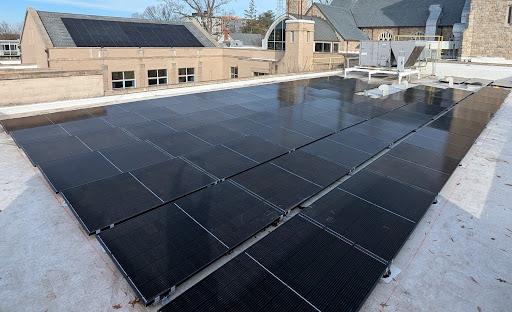
- Since 2003 St. Columba’s has acquired 100 percent of its electricity from renewable energy, and we also encouraged parishioners to purchase renewable energy for their homes. In 2015, 56 solar panels were installed on the roof of the Great Hall – producing roughly 13,500 kilowatt-hours of clean energy annually at a cost 40% below utility rates. and in 2025 our solar array was replaced and expanded to the roof over the Music Wing, 145 panels in all. Our solar energy and energy efficiency improvements are saving St. Columba’s $100,000 a year.
- We arranged for a free energy audit of the church, and from the purchase of more efficient windows and light bulbs (first CFLs, then LEDs) to the installation of a high-efficiency heating system, St. Columba’s has made the elimination of energy waste a hallmark of its capital improvements, including the recent renovation of the nave. These steps include programmable thermostats, motion sensors for lighting, low-flow toilets, and LED Christmas lights.
- When the Environment Committee was founded, not even the service leaflets were being recycled. First paper, then cans and bottles, and now even electronic equipment are recycled in both the church and the nursery school, and food waste is composted.
- The Vestry adopted our proposed “zero waste” policy as standard practice for all activities at the church. Volunteers gather and wash ceramic coffee cups and dishes, and bins are provided for both recycling and compost, including drink cups, tableware, plates and napkins.
- The renovation of the nave completed in 2021 not only restored and beautified the sanctuary but enhanced many environmental features. For example, the new roof uses LEED-certified materials and reflects 80 percent of sunlight, while providing a longer lifespan. Also, energy-efficient LED lights were installed in the nave and narthex, rain barrels were repaired, and our landscaping has incorporated native plants.
- Many outdoor improvements can be credited to ST. C’s Nursery School science teacher Kate McLynn’s leadership – installing first one and then multiple rain barrels (capturing polluted runoff); planting and nurturing new trees and a butterfly garden; putting a green roof on one of our sheds; and obtaining a grant from RiverSmart DC that helped us install storm water collection grates to manage the water on our courtyard and even build a stream!
- This amazing project captures our rainfall runoff into a retention tank (and artificial stream) that protects properties downhill and filters contaminants from the water. An existing underground stormwater facility was discovered during construction and put to use – sending any overflow to the city storm water pipes in the street.
- Over the years we also:
- Received and installed a steel bike rack from the DC government;
- Introduced the congregation to fair-trade, shade-grown organic coffee;
- Designed and sold reusable cloth shopping bags with a “St. Columba’s” illustration;
- Enabled parishioners to get freshly picked, organically grown produce from a local farm on a weekly basis (Community Supported Agriculture);
- Supported the annual Mother’s Day plant sale led by Henry Beale, raising money for Sustainable Villages Honduras and sharing leftover plants with Housing Up to start a garden for the kids.
Education and engagement
- The Environment Committee has emphasized both learning and doing – sharing our concerns with the parish and encouraging individual action. We have promoted good environmental practices in the Common on many occasions, and every month or so 300 St. Columbans receive a newsletter from Reid Detchon about Committee plans, other environmental news and events, and spiritual reflections. (Sign up here to get it!)
- We have also offered numerous classes as part of Wednesdays at St. C’s including a five-part workshop on “Living Green,” with concrete and practical options to live a more Earth-friendly life.”
Finally, to follow the maxim “think globally, but act locally,” we have:
- Organized many spring cleanups – of our own grounds (on “outdoor Decoration Sunday”), our waterways (Rock Creek, Broad Branch, Soapstone Creek, and the Anacostia), and our urban forests, with Ward 8 Wood Conservancy;
- Arranged boat tours of the Anacostia River;
- Joined as an early partner and financial supporter of Interfaith Power & Light (DC.MD.NoVA);
- Offered an “Alternative Gifts Fair” as part of Reach Out at Christmas to encourage parishioners to make donations in honor of friends and family;
- Installed solar panels on a low-income home along with Rebuilding Together;
- Wrote letters to likely environmental supporters, urging them to vote.
- Taken up the cause of the Trinidad Conservation Project (now Sustainable Villages Honduras) – a partnership born in 2006 as the Honduras Mission Group at St. Columba’s together with St. Mark’s, Capitol Hill. Initially a tree planting program after the devastation caused by Hurricane Mitch in 1998, it has since grown into a broader initiative promoting sustainable agriculture, community building, and improving rural family income, nutrition, and health, while protecting vulnerable mountain forests and water supplies. Listen to Noreen O’Meara and Tom Bauder share their stories of engagement on short Daily Bread videos.